How many of you are left? I have come across a lot of blogs who have given up or who never even started!
Don't forget: if you don't keep your posts up to date, you will eventually be deleted from the list.
Anyway, today's story is my third Hayao Miyazaki film! In case you couldn't tell, I can't get enough of Mayazaki movies. This one is technically pre Studio Ghibli, but it's been re-released by now.
Today's 2015 April A to Z Blogging Challenge story for the letter N:
Nausicaä of the Valley of the Wind
This one was actually a Manga first, also written by Miyazaki-san, and was then adapted into an animated feature film. Not his first film ever, but probably considered by most to be his breakthrough.
I couldn't pick just one story for the letter M, so I picked two! My two favorites.
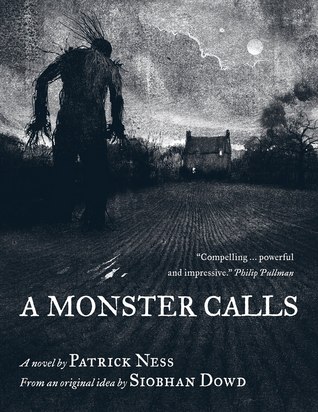
First is another Patrick Ness novel, which in case the story itself wasn't already poignant enough, is a tale he wrote finishing an idea a friend and fellow writer of his, Siobhan Dowd, had before she died.
Is that something in my eye?
Today's first 2015 April A to Z Blogging Challenge story for the letter M:
But it isn't the monster Conor's been expecting. He's been expecting the one from his nightmare, the one he's had nearly every night since his mother started her treatments, the one with the darkness and the wind and the screaming...
This monster is something different, though. Something ancient, something wild. And it wants the most dangerous thing of all from Conor.
But like I said, today I have something special for you.
Two stories!
A book by one of my favorite authors, and a film by my favorite writer and director of animated features, the legend, Hayao Miyazaki.
Not only is Princess Mononoke a great film, it is, in my humble opinion, Miyazaki-san's greatest achievement. I did a list of my favorite Miyazaki films a while back on this blog, you can find it on my series page.
Anyway, how is your challenge going? I actually got behind on posting, and I've slowed down a little with my visiting, but I'm otherwise still going steady.
Today's second 2015 April A to Z Blogging Challenge story for the letter M:
On a journey to find the cure for a Tatarigami's curse, Ashitaka finds himself in the middle of a war between the forest gods and Tatara, a mining colony. In this quest he also meets San, the Mononoke Hime.
Are you hitting your stride yet? My posting is going great, of course, but my blog visiting has been up and down.
So ... technically, as you can probably tell from the poster, this animated feature film is called Castle in the Sky, at least in the US released version.
The original title though is Laputa, or at least some kind of Japanese translation of that. It comes, of course, from the flying island described in the 1726 book Gulliver's Travels by Jonathan Swift.
Today's 2015 April A to Z Blogging Challenge story for the letter L:
All this week I'll be blogging about my five favorite animated feature films written and directed by Hayao Miyazaki. Miyazaki is a Japanese film director, animator, manga artist and screenwriter. He also co-founded Studio Ghibli, one of Japan's most well known animation film studios.
1997's Princess Mononoke is probably the greatest animated film ever made, with the possible exception of Akira, which is a topic I could debate for hours, even by myself. If I was pressed I would probably say Princess Mononoke is the best fantasy animated feature, and Akira is the best Sci-Fi. That way, they can both be best. Here's the summary, from IMDB:
On a journey to find the cure for a Tatarigami's curse, Ashitaka finds himself in the middle of a war between the forest gods and Tatara, a mining colony. In this quest he also meets San, the Mononoke Hime.
Where do I even start with this movie? Well, for one thing, Spirited Away may have won an Academy Award, but keep in mind, Best Animated Feature only became an Oscar after 2001. If it had existed when Mononoke came out? The Princess would have won hands down. Or bows down, whatever.
I don't want to even say too much about this movie. It's ... it's that awesome. I'll just say this: the setting is probably the coolest world I've ever encountered outside of perhaps Middle Earth. Technically, the film is supposedly set in the Muromachi Period of feudal Japan, but that's never made clear, and there is no question that other than having a contemporary technology level for that period in Nippon's history, the setting isn't even close to realistic.
Or is it? If you're Japanese, and Shinto, or even Buddhist, you have some very interesting beliefs. You believe in Kami. You believe in Oni. You believe inanimate objects have souls (Obake).You believe gods and spirits walk the earth every day, just an humans do. It's this rich spiritual tradition in Japan that makes movies like Princess Mononoke so deep. The mythology, while original and unique, is still based on a complicated and entrenched system of spiritual history (think how The Lord of the Rings is made so much stronger by the mythology of The Silmarillion).
Anyway, look, like all Miyazaki films, I could go on about this one forever. The bottom line is that this movie is a must-see, especially for any writer of speculative fiction, in which building entire living, breathing worlds is key.
And now that this series is done, let me point you to some related entertainment: Honorable mentions by Hayao Miyazaki:
NOTE: I have not personally seen Porco Rosso, but I'm told it's wonderful.
Honorable mentions from Studio Ghibli:
Whisper of the Heart (Miyazaki wrote but did not direct--and this is a fabulous film for any creative type person to see--I'm serious, all writers MUST see this film)
All this week I'll be blogging about my five favorite animated feature films written and directed by Hayao Miyazaki. Miyazaki is a Japanese film director, animator, manga artist and screenwriter. He also co-founded Studio Ghibli, one of Japan's most well known animation film studios.
Based heavily on the Japanese religion, Shintoism, 2001's Spirited Away is possibly Miyazaki's scariest film, but it may also be his most unique. It is his only film to win an Academy Award (2003 Best Animated Feature). 10-year-old Chihiro is a precocious little girl, whose curiosity gets the best of her when her family, during their move to the suburbs, takes a wrong turn and accidentally discovers what they think is an abandoned amusement park. From IMDB:
In the middle of her family's move to the suburbs, a sullen 10-year-old girl wanders into a world ruled by gods, witches, and monsters; where humans are changed into animals; and a bathhouse for these creatures.
This is probably the most Japanese of Miyazaki's films as well. Inside the amusement park, Chihiro's parents are trapped by their own greed, and transformed into pigs. From there begins a harrowing adventure in which the young girl must attempt to escape from a bathhouse which serves as a rest stop for the spirit world. From the witch Yubaba and her sister Zeniba, to paper shikigami, to spider yokai, to a dragon named Haku/Sen, to a stink spirit, Spirited Away is filled with the most strange and wonderful cast of characters of any animated film that I have ever seen.
Though on the surface this is a story about a young girl, it's a very mature and nuanced tale. The liminal journey she takes is almost ritualistically psychedelic in nature, and I could imagine small children being quite scared by certain aspects of this film. When Yubaba steals Chihiro's true name, the innocence of her childhood is essentially left behind.
Nonetheless, this is an excellent movie. The animation and artistry alone make this one of my all time favorite animated films. An absolute must-see.
All this week I'll be blogging about my five favorite animated feature films written and directed by Hayao Miyazaki. Miyazaki is a Japanese film director, animator, manga artist and screenwriter. He also co-founded Studio Ghibli, one of Japan's most well known animation film studios.
1988's My Neighbor Totoro may be the most adorable animated movie ever made. It's especially enjoyable for families with young children, because its innocence and curiosity mirror the vigorous interest of young minds, but its mystery and underlying themes are sophisticated enough to keep even the most discerning parent entertained. From IMDB:
When two girls move to the country to be near their ailing mother, they have adventures with the wonderous forest spirits who live nearby.
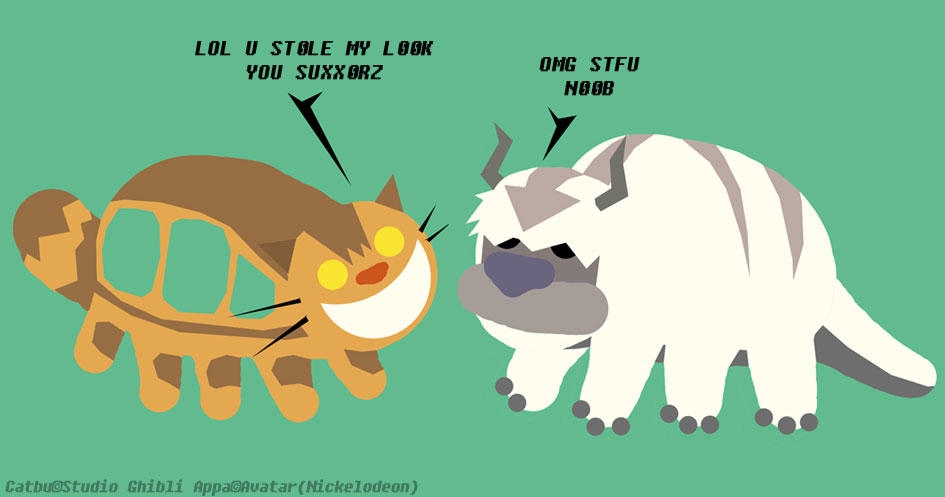
Totoro is a simple, quiet film, full of adorable spirits, and fabulous creatures, which I find absolutely endearing, even if my friend, Adam, is creeped out by Catbus (follow those links, Adam, you'll love the last one). That said, there are some serious themes at work as well: conservation, the environment, the fear of moving into a new place, and imagination in general.
All in all, I think this quote from Roger Ebert sums it up well: "one of the lovingly hand-crafted works of Hayao Miyazaki ... My Neighbor Totoro is based on experience, situation and exploration—not on conflict and threat ... it would never have won its worldwide audience just because of its warm heart. It is also rich with human comedy in the way it observes the two remarkably convincing, lifelike little girls ... It is a little sad, a little scary, a little surprising and a little informative, just like life itself. It depends on a situation instead of a plot, and suggests that the wonder of life and the resources of imagination supply all the adventure you need."
All this week I'll be blogging about my five favorite animated feature films written and directed by Hayao Miyazaki. Miyazaki is a Japanese film director, animator, manga artist and screenwriter. He also co-founded Studio Ghibli, one of Japan's most well known animation film studios.
1984's Nausicaä of the Valley of the Wind is one of the first Science-Fantasy tales I ever came across (as in guns, motorized gliders, giant-airships, but also knights and swords and monsters). Technically, it's actually a post-apocalyptic setting, but you wouldn't necessarily know that unless you'd read the manga. From IMDB:
Warrior/pacifist Princess Nausicaä desperately struggles to prevent two warring nations from destroying themselves and their dying planet.
Nausicaä is a young princess, who rules the Valley of the Wind, and spends much of her time researching the mutant giant insects in the poisonous jungles surrounding her homeland. When the kingdom of Tolmekia invades, and tries to use ancient technology they don't understand to destroy the jungle, Nausicaä must convince them of the errors of their ways.
Set in one of the most fabulous landscapes, and containing some of the most iconic creatures ever to grace the animated silver screen, including the gigantic, armored caterpillars/trilobites called Ohmu, Valley of the Wind is Miyazaki's second feature film. And though it is not technically a Studio Ghibli production, it is considered by most the spiritual antecedent to that studio's rise to fame.
Upon it's English re-release, the film continued in the Miyazaki tradition of casting famous actors to voice the adaptations, and included such heavyweights as Patrick Stewart, Uma Thurman, Mark Hamill, and Eward James Olmos.
I could not actually find an official trailer, because this movie is old and somewhat rare, but this one will give you a good idea of the tone of the film:
All this week I'll be blogging about my five favorite animated feature films written and directed by Hayao Miyazaki. Miyazaki is a Japanese film director, animator, manga artist and screenwriter. He also co-founded Studio Ghibli, one of Japan's most well known animation film studios.
So, today is about my fifth favorite Miyazaki film. 2008's Ponyo is the quintessential Miyazaki film. Set in a contemporary Japanese coastal town, it features his well known mix of realism and fantasy. From IMDB:
An animated adventure centered on a 5-year-old boy and his relationship with a goldfish princess who longs to become human.
This movie is absolutely adorable. The relationship between Sosuke and Ponyo is brimming with adventure, and that tender kind of love that only comes with first friendships. There is an underlying environmental theme, but it's subtle, and the magic that occurs throughout the tale feels just right, with only a hint of the seriousness of it all hovering beneath the surface.
I could go on forever about this film, as I could for all Miyazaki features, but I'll just leave you with the trailer, so you can all get back to your days:
NOTE: If you're here from A to Z, please be sure to follow, and you can grab the badge and the header for your own blog, from the A to Z blog. Thanks!




+Japan_1.jpg)
+1.jpg)

+1.jpg)