I'll just leave this here:
Showing posts with label Animals. Show all posts
Showing posts with label Animals. Show all posts
Friday, December 20, 2013


Wednesday, December 22, 2010
Medicine Wheel
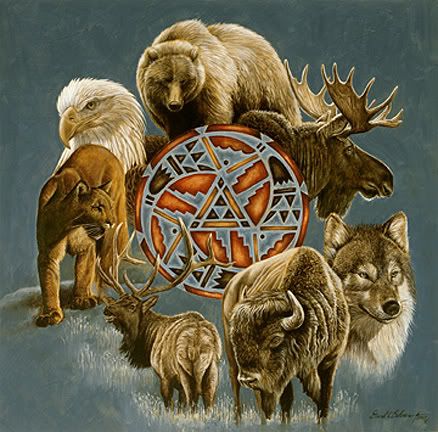
For the third part in this series I promised to go into the concept of the Medicine Wheel. A Medicine Wheel, or a Sacred Hoop, is first and foremost a physical circle, usually made from rocks, that is used to represent the directions, both cardinal and spiritual, in many Native traditions. But the wheel also exists in the air, and in the mind.
The wheel generally had certain colors, animals and directions associated with it, but which ones go where can very from culture to culture. I will share what I remember from my own experiences, but please don't assume that this information will be the same in every instance.
The Wheel is always divided into four main parts (five if you count the center as separate). Each section is associated with a cardinal direction. North is usually associated with elders, wisdom and introspection. North is represented by Brother Bear, Cedar, the wind and winter. It is most often drawn in black or white.
South is associated with youth, with young people in the twilight of their adolesence, along with passion, fertility, and energy. The South is represented by Sister Wolf, Sweetgrass, Earth and summer. Its color can vary but is often shown as red or yellow.
The East is associated with children, the dawn, and change. The East is represented by Eagle, Tobacco, fire and spring. The color also varies, but is sometimes green or yellow.
The West is associated with adulthood, responsibility, reflection. The West is represented by Buffalo, Sage, water and autumn. Its color is usually blue.
My understanding is that each Totem Animal falls into one of these categories, but I honestly can't remember (except for the main four listed here) which ones go where. You should be able to find this kind of information in some of the books I listed yesterday.
Now I will try to continue where we left off yesterday, and share some details of the less common Spirit Animals.
Dolphin: Dolphin symbolizes kindness and play energy. Dolphin has also always been seen as a messenger by many different cultures. Although it is a mammal, it lives in the sea, and has mastered the art of breath control, sometimes spending impossible amounts of time deep underwater without breathing. Since water is the symbol of life Dolphin brings us teachings from the water of life. Dolphin reminds us that time to play and relax is a crucial element to walking in balance throughout life’s journey. He tells us to move with the ebb and flow of life, and not against it.
Dolphin Medicine includes change, balance, harmony, communication, freedom, trust, understanding, the power of rhythm in life, the use of breath to release emotion and significant water power.
Dolphin Medicine includes change, balance, harmony, communication, freedom, trust, understanding, the power of rhythm in life, the use of breath to release emotion and significant water power.
Cat: Native American tradition only refers to American cats like cougar, puma, and jaguar, but it should be safe to assume that the power behind all great cats is similar. Cat's are known for their fierce independence as well as their artful mystique. People with cats for Spirit Guides are usually wise leaders who teach others through example and without ego.
Cat's Medicine is independence, curiosity, many lives, cleverness, unpredictability, healing, the ability to defend oneself fiercely when backed into a corner, and seeing the unseen.
Turtle: Turtle has always been seen as patient and tenacious. Turtles are known for making long, slow journey without ever deviating from the path.
Turtle's Medicine includes being a symbol for the Earth, connection with the center, navigation, patience, femininity, self-reliance, commitment, and non-violent defense.
Monkey: Monkey is not commonly referred to in Native culture, because they are not common in North America, but Monkey is generally known for cleverness and mischief.
Monkey's Medicine includes movement through ego, ability to change their environment, family, understanding excess, health, and understanding success.
Now I will try to break down two very specific examples, just for fun, and because two of my friends apparently really want to know what they mean.
Wolverine: Wolverine is thought of by many Native tribes, interestingly enough, as the Hyena of the North. Wolverines are very clever, and so are associated with the Trickster. A Wolverine also controls an extremely large territory in the wild, usually with no others of their species living within several miles, so they are often considered loners.
Wolverine's Medicine is made up of being considered the "last phantom of the wilderness." They are also associated with revenge, craftiness, resistance to cold, aggression, standing up for yourself and standing your ground, fierceness, elusiveness, strength, endurance, and courage.
Giant Sloth: A Sloth is like what? Part ant-eater and part bear? Sloths are generally folivores, but some have been known to eat insects and small birds to supplement their diets. I'm not sure how they catch them though, because Sloths are mainly known for being slow and plodding, and are certainly not known as great predators.
Sloth's Medicine includes persistence, rest, reflection, and balance. Sloth is known for being patient, friendly and adorable, or at least the ones we have left here on Earth are.
Space Monkey: Space Monkeys are mainly known for not actually existing, but hey, some people think Zombies don't exist either. Of course there are the actual primates that were sent into space by the government, to test for the safety of going into orbit, before sending humans, and I would imagine that those adorable little fellows would have to be known for their courage and their curiosity.
Space Monkey's Medicine includes droppin mischief on substitute teachers, overstating the value of corndogs to strangers, dealing with stinky burp breath, and breaking the universe with a cosmic space kapow!
So that's it folks. Have a very Merry Christmas and a Happy New Year!
The blog should go back into action on Monday, January 3rd, and will hopefully be able to get back to some slightly more serious business.
Tuesday, December 21, 2010
Spirit Animals
So now that you all know a little bit about my limited history with Vision Quests, I want to tell you some more about Spirit Animals, also known as Totem Animals, or Spirit Guides. I'm not going to pretend to be an expert, so if you really are interested, please find a true Native American shaman or Medicine Man (or woman) that you can talk to about the subject. You might be surprised how willing they are to share about their culture. You can also do some research on your own.
Two good articles I know of online are at the Manataka American Indian Council, and AnimalSpirits.com. There are also several books. Two decent examples are ANIMAL-SPEAK: The Spiritual and magical powers of creatures great and small by Ted Andrews, and POWER ANIMAL MEDITATIONS: Shamanic Journeys with Your Spirit Allies by Nicki Scully. There is a fun quiz, that can tell you a little more about Spirit Animals, but is also meant to promote a book and should not be taken wholly seriously, here at Jeri Smith-Ready.com.
Dog: Among many tribes Dog was the sentinel who guarded the tribe’s home and protected them from attack and warned them of coming danger. He helped during the hunt and gave them warmth when it was cold. Dog is a symbol of loyalty, unconditional love, and protection, so if Dog is your Spirit Guide I would guess that you are a good, fast friend when you grow close to someone.
Dog’s Medicine incorporates the loving kindness of the best friend and the protective energy of the guardian. If Dog is your Spirit Animal then you’re a very kind and giving person whose devotion to their family and friends is unwavering. However, you must be careful not to be too trusting or be taken in by those who would take advantage of you. Make sure you always give your loyalty to those who are right and true.
Snake's Medicine includes elusiveness, transmutation, goddess energy, exploration of the mysteries of life and connection to the magic cord by which the shaman travels to the spirit world.
Bear’s Medicine includes introspection, healing, solitude, wisdom, change, communication with Spirit, the cycle of death and rebirth, transformation, and being the creature of dreams, shamans and mystics.
Two good articles I know of online are at the Manataka American Indian Council, and AnimalSpirits.com. There are also several books. Two decent examples are ANIMAL-SPEAK: The Spiritual and magical powers of creatures great and small by Ted Andrews, and POWER ANIMAL MEDITATIONS: Shamanic Journeys with Your Spirit Allies by Nicki Scully. There is a fun quiz, that can tell you a little more about Spirit Animals, but is also meant to promote a book and should not be taken wholly seriously, here at Jeri Smith-Ready.com.
So, now that we've gotten past all that I'm going to go over some of the details about some of the most common Spirit Animals. All of these are examples that exist currently in my WIP. I'm hoping it's a scene I don't have to cut during the re-write. I will go over some more obscure examples (as well as I can) for you guys tomorrow.
Dog: Among many tribes Dog was the sentinel who guarded the tribe’s home and protected them from attack and warned them of coming danger. He helped during the hunt and gave them warmth when it was cold. Dog is a symbol of loyalty, unconditional love, and protection, so if Dog is your Spirit Guide I would guess that you are a good, fast friend when you grow close to someone.
Dog’s Medicine incorporates the loving kindness of the best friend and the protective energy of the guardian. If Dog is your Spirit Animal then you’re a very kind and giving person whose devotion to their family and friends is unwavering. However, you must be careful not to be too trusting or be taken in by those who would take advantage of you. Make sure you always give your loyalty to those who are right and true.
Snake: Snake is a symbol of cunning and ingenuity, but also of rebirth. If Snake is your Spirit Guide it is possible that you are an old soul and this is not your first time in the world.
Snake's Medicine includes elusiveness, transmutation, goddess energy, exploration of the mysteries of life and connection to the magic cord by which the shaman travels to the spirit world.
Horse: Horse has shown up in almost every single mythological tale. From Pegasus, to Sleipnir, the eight-legged horse of Odin; from the stallions of Surya the Hindu sun god to the stallions of Apollo. No single creature has provided man with the freedom of movement and the ability to travel over long distances as has the horse. If you are drawn to Horse, you may feel a power in your spirit that is sometimes difficult to reign in, but remember, not all who wander are lost.
Horse's Medicine is made up of power, stamina and endurance. He is also known for faithfulness, freedom, awareness of the power achieved through cooperation, communication between the species (and between cultures), and the ability to overcome obstacles.
Rabbit: Rabbit may be stereotyped as being a fearful, simple animal, but in fact they are quite ingenious, especially when it comes to working together. Among Native Americans they symbolize humility.
Rabbit's Medicine includes moving through fear, living by your wits, and receiving hidden teachings and intuitive messages, as well as quick thinking and relying on your instincts. Rabbit reminds us not to be afraid and that we cannot allow our fearful thoughts to reproduce (especially not like rabbits) for they will overcome us if we let them.
Fox: Fox symbolizes cunning, agility, and being quick witted and thinking on your feet.
Fox's Medicine is very interesting and is associated with the Trickster, almost as much as Coyote. Fox stands for shape-shifting, cleverness, unseen observation, stealth, feminine courage, persistence and gentleness.
Owl: Owl stands for deception, clairvoyance and insight, but in this context deception does not carry with it a negative connotation. Deception is often necessary for one’s survival and can be a very valuable tool. The Great Horned Owl is the only bird that can out fly the Golden Eagle so stamina probably ought to go along with those other things as well. Owl is a bird of prey so it can also stand for a person who is a great warrior, especially if that which is dear to its heart is threatened. Owl is also known for his great awareness and his ability to see everything around him, having vision that reaches for almost three hundred and sixty degrees.
Owl’s Medicine consists of seeing through masks and disguises, silent and swift movement, keen sight, messenger of secrets and omens, shape-shifting, link between the dark, unseen world and the world of light, comfort with the shadow self, moon power, and overall freedom and independence.
Bear: Bear has always stood for wisdom, power, and healing and has been associated with the North. Bears spend the winter months in hibernation and among Native people the symbolism of the Bear’s cave reflects returning to the womb of Mother Earth. People with Bear Medicine are considered by many as self-sufficient and would rather stand on their own two feet than rely on others.
Bear’s Medicine includes introspection, healing, solitude, wisdom, change, communication with Spirit, the cycle of death and rebirth, transformation, and being the creature of dreams, shamans and mystics.
This post is going on a little too long, but I promise not to stop here. I'll just have to break it up a little and pick up tomorrow where we left off today. Before we're done though I briefly want to introduce the idea of the Medicine Wheel. The Medicine Wheel is a little like a compass, and is associated with the cardinal directions. I'll go into it more tomorrow, but if you're curious you can read some more here, at SpiritualNetwork.net.
Thanks everybody, and please be sure to come back tomorrow!
Friday, December 17, 2010
What is your Patronus?
First of all I owe any and all credit for this post to my buddy Lydia K, from The Word is my Oyster. She came up with this awesome question and posted about it yesterday (this post, my post, was supposed to go up on Thursday, but I got sick). If you haven't been there, please stop by to read her super fun post, comment on it, and follow her blog. She also has an awesome feature, Medical Mondays, which is not only really entertaining, but extremely useful for writers.
So anyway, hopefully you've all read the Harry Potter novels, more specifically Harry Potter and the Prisoner of Azkaban, where the Patronus Charm first appears. For those of you who haven't, here is the description from the Harry Potter Wiki:
A Patronus Charm is an insubstantial animal protector created by the advanced Patronus Charm spell, and one way to defend against Dementors and certain other Dark creatures. The spell requires the use of a wand, concentration on a powerfully happy memory, and the incantation "Expecto Patronum".

A Patronus that is fully formed, or corporeal, takes the shape of fairly solid-looking animal; a non-corporeal Patronus appears only as wisps of silvery mist. It is a very complex charm and many qualified wizards and witches have trouble with it. Harry Potter is one of the youngest known wizards to cast a Patronus. The Patronus Charm, like Animagus forms, has been said to reflect the personality or feelings of the witch or wizard. They are, however, subject to change if the caster goes through an emotional upheaval of some sort.
Anyway, before I go on any longer about the awesomeness that is All Things Harry Potter the point of this post is: what kind of animal do you think your patronus (assuming it manifested itself as fully corporeal) would show up as?
Lydia, being both a doctor and a clever writer, argued first that hers would be a Paramecium, then she selected a Kiwi (the bird, not the fruit) for a moment before finally settling on a Platypus.
My own Patronus would manifest itself as a Mountain Lion, also known as a Cougar, I'm quite confident. How do I know this, you ask? Because as a teenager I went on a Vision Quest, and discovered that the Mountain Lion is my Spirit-Animal.
I fully realize that may sound crazy, but I'm not joking.
More on Vision Quests and Spirit-Animals next week (although if you name your Patronus Animal in the comments, I promise to break down what that would mean as your Spirit Animal, in another post).
So anyway, hopefully you've all read the Harry Potter novels, more specifically Harry Potter and the Prisoner of Azkaban, where the Patronus Charm first appears. For those of you who haven't, here is the description from the Harry Potter Wiki:
A Patronus Charm is an insubstantial animal protector created by the advanced Patronus Charm spell, and one way to defend against Dementors and certain other Dark creatures. The spell requires the use of a wand, concentration on a powerfully happy memory, and the incantation "Expecto Patronum".
A Patronus that is fully formed, or corporeal, takes the shape of fairly solid-looking animal; a non-corporeal Patronus appears only as wisps of silvery mist. It is a very complex charm and many qualified wizards and witches have trouble with it. Harry Potter is one of the youngest known wizards to cast a Patronus. The Patronus Charm, like Animagus forms, has been said to reflect the personality or feelings of the witch or wizard. They are, however, subject to change if the caster goes through an emotional upheaval of some sort.
Anyway, before I go on any longer about the awesomeness that is All Things Harry Potter the point of this post is: what kind of animal do you think your patronus (assuming it manifested itself as fully corporeal) would show up as?
Lydia, being both a doctor and a clever writer, argued first that hers would be a Paramecium, then she selected a Kiwi (the bird, not the fruit) for a moment before finally settling on a Platypus.
My own Patronus would manifest itself as a Mountain Lion, also known as a Cougar, I'm quite confident. How do I know this, you ask? Because as a teenager I went on a Vision Quest, and discovered that the Mountain Lion is my Spirit-Animal.
I fully realize that may sound crazy, but I'm not joking.
More on Vision Quests and Spirit-Animals next week (although if you name your Patronus Animal in the comments, I promise to break down what that would mean as your Spirit Animal, in another post).
Subscribe to:
Posts (Atom)